Metalius Restoration Hamilton Clinton Township
📞 908-560-5406
Property Damage Restoration Hamilton Township, NJ
24/7 Emergency Response

Sewage Cleanup in Clinton Township.

Black-water cleanup across Hunterdon County under S500 Cat-3 standards. Carpet, pad, drywall to flood-line — out. Hard surfaces — decontaminated.

📞 908-560-5406 Local team in Clinton Township 24/7 dispatch
Sub-Hour Average on-site response time
Pre-Staged Equipment ready for surge events
Multi-Unit COIs on file at major buildings
Service Overview

How We Approach It

Standard homeowners insurance does NOT cover sewer backup unless you have a sewer/water backup endorsement on your policy. The endorsement costs $50-150/year typically. Without it, you pay out of pocket. We document the loss type so the right coverage applies.

What's Included

  • IICRC S500 Cat-3 protocol
  • Full Tyvek + HEPA respirator PPE
  • Porous-material removal to flood line
  • EPA-registered antimicrobial
  • Air quality clearance before reconstruction
  • Insurance documentation

Prevention Measures That Actually Work

If you have had a sewer backup once at a Clinton Township property, the conditions that caused it likely still exist. Prevention reduces the chance of a repeat.

  • Backwater valve on lateral drain. A one-way valve installed between your basement plumbing and the city main. When sewer pressure tries to push water back into your basement, the valve closes. Cost: $1,500-3,500 installed. The single most effective prevention measure for properties on combined-sewer or older municipal systems.
  • Sump pump with battery backup. If your basement has a sump pit, a battery-backup pump keeps it running during the power outages that often accompany the same heavy rain events causing sewer backups. Cost: $400-900 for the battery backup add-on.
  • Floor drain plug or standpipe. Mechanical or air-pressure-operated plug that seals your floor drain when reverse pressure is detected. Cost: $50-300. Less reliable than a backwater valve but cheaper.
  • Elevate vulnerable contents. If you have a finished basement, elevate electrical outlets, store boxes off the floor, do not place irreplaceable items at floor level. Mitigation matters when prevention fails.

Our crew does not install these — they are plumbing scope, not restoration scope — but we can refer to qualified plumbers in the Clinton Township area who do this work routinely.

What to Do During an Active Sewer Backup

  • Stay out of the affected area. The water is contaminated. Children and pets out, contents that can be removed safely (without wading) come out, anything you can lose to the loss is acceptable risk if it keeps people out of the contaminated water.
  • Do not use plumbing in the house. Every flush adds to the volume of contaminated water. Stop water use at all fixtures until the backup is resolved.
  • Call us. We respond with full Cat-3 PPE and protocol. Dispatch confirms loss type so the truck arrives equipped for sewage rather than clean water.
  • If you have insurance with the endorsement, open the claim before we arrive so we have the claim number for direct billing. If you do not have the endorsement, we will discuss out-of-pocket scope at our first on-site visit.
  • Document with photos from a safe distance. Wide shots of the affected area, close-ups of any visible contamination, photos of the water source if visible. These become the foundation of the insurance scope.

Our standard Clinton Township response time for active sewer backups is within the hour. The faster we get there, the less material has to come out and the smaller the eventual reconstruction scope.

Process

Our Process

  1. 01

    Phone Triage

    Real human dispatch from Clinton Township. We sort loss type on the first call so the truck arrives equipped for what we are walking into.

  2. 02

    On-site Assessment

    Photos of every wet surface, moisture readings of every substrate, written cause-of-loss narrative, confirmation the source is fully off.

  3. 03

    Containment + Extraction

    Standing water removed first. Affected areas isolated to prevent spread. Damaged porous material cut to documented flood line and bagged for disposal.

  4. 04

    Documented Drying

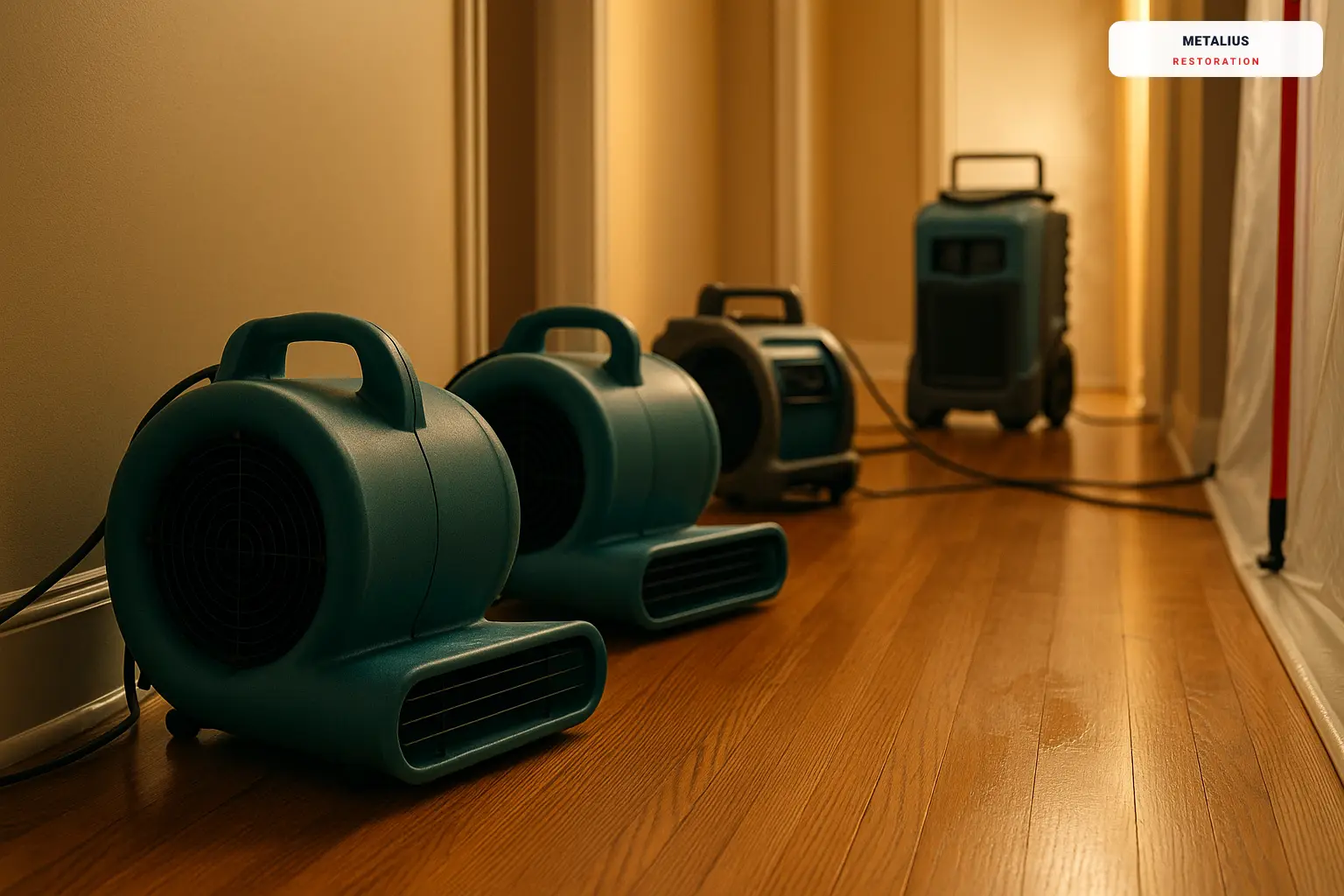
    Industrial drying equipment sized for the loss volume. Daily moisture readings logged on a building diagram. Equipment runtime tracked for the insurance claim.

  5. 05

    Reconstruction + Walkthrough

    Drywall, flooring, paint, trim — all matched to pre-loss condition. Final walkthrough confirms the work is done before the project closes.

24/7 Emergency

24/7 emergency response across Hunterdon County. Real human, real truck, real fast.

We dispatch a tech 24/7 across the Clinton Township metro. Average on-site time is under an hour.

Call 908-560-5406
The difference

Why Customers Choose Us

Real reasons. No invented stats, no manufactured awards.

  • 01

    24/7/365 Emergency Response

    Holidays, weekends, middle of the night — same response standard. Property losses do not check the calendar. Neither do we.

  • 02

    Multi-Unit + Commercial Capable

    COIs on file at most major Hunterdon County multi-unit buildings. After-hours noise scheduling for tenant-occupied commercial. Per-unit documentation discipline for HOA + condo claims.

  • 03

    Pre-Staged For Surge Events

    Storm season we add equipment + tech capacity at our Clinton Township base. When the call volume spikes after a major weather event, individual response times do not slip.

Service Area

Serving Hunterdon County

Our Clinton Township dispatch covers a tight radius across Hunterdon County. The compact service area is intentional — restoration work scales with response time, and minutes save material. Clinton Town, Lebanon Township, and Flemington all reach inside 30 minutes during normal traffic.

Counties Covered

  • Hunterdon County, NJ

Cities We Service

Each Hunterdon city below opens a local page with arrival times from our Clinton Township base and the loss patterns we handle most often in that municipality.

Not sure if you're in our area? Call 908-560-5406 and we'll tell you in 30 seconds.
FAQ

Frequently Asked Questions

If you don't see your question, just call or message us.

Can you work in occupied condo and apartment buildings? +

Yes — we have COIs ($2M general liability + workers comp, additional insured naming the building) on file for most major condo and apartment complexes in our service area. We work within building noise windows, use service elevators, and coordinate with building management on access protocols. For larger buildings we are pre-cleared for vendor approval so paperwork does not delay active-loss response.

How do you decide what materials to remove vs save? +

IICRC S500 has clear material removal criteria based on water category and how long the material was wet. Cat-1 water + reached within 24-48 hours = often save in place. Cat-3 water = porous materials always come out. Borderline cases get the moisture-meter test: substrate that returns to dry standard with equipment runtime gets saved; substrate that stalls above dry standard for 5+ days gets removed.

What certifications do your technicians hold? +

Our crew holds IICRC certifications in Water Damage Restoration (WRT), Applied Structural Drying (ASD), and Applied Microbial Remediation (AMRT) per IICRC S500/S520 standards. Specific cert status of any technician on your job is available on request — we do not stretch certifications we do not actually hold.

Do you offer free estimates? +

For property losses (water, fire, storm, sewage), we provide a no-cost on-site assessment and an Xactimate scope of work. For non-emergency reconstruction or mold remediation we provide a written estimate after on-site evaluation. We do not give phone-quote prices for restoration work — accurate scoping requires seeing the loss in person.

What happens if mold is found during the dry-out? +

If we discover existing mold growth during a water restoration job — which happens when a slow leak was already growing mold before the recent loss — we contain that area immediately and remediate per IICRC S520 before reconstruction starts. The discovery becomes a supplemental scope item for the carrier. Done correctly, both the water loss and the pre-existing mold get resolved as one coordinated project.

How do you document moisture readings for insurance? +

We map every wet substrate on a building diagram, take initial moisture readings with calibrated meters, log readings at every daily monitoring visit, and compare against the manufacturer's dry-standard for that material. Final clearance readings show every wet substrate returned to baseline. Adjusters get the full record — building diagram, meter readings by date, equipment run logs. This is what gets the claim approved without back-and-forth.

Do you handle storm damage to roofs? +

Emergency tarping yes — we secure compromised roof openings to prevent further weather intrusion. Permanent roof replacement we coordinate with a licensed roofing contractor in our network rather than doing in-house. The water damage that follows roof intrusion is our scope; the structural roof itself is a roofer's scope. We handle the coordination so you have one project manager not two.

Call Now • Clinton Township

Need Restoration in Clinton Township? One Call Gets a Crew Moving.

One phone call gets a truck rolling. Real Clinton Township team, real local response time, no automated phone tree. We'll be on site fast.

📞 Tap To Call 908-560-5406

24/7 Emergency Dispatch

📞 Call 908-560-5406